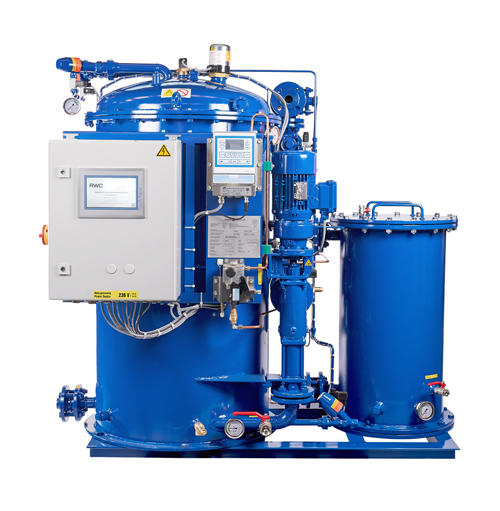
Oil-water separator (OWS) are designed to effectively remove oil particles from water before it is discharged overboard from areas such as engine room bilges, cargo holds, oil tanks, or other oil-contaminated spaces. The treated water must contain no more than 15 parts per million (ppm) of oil before it can be released into the sea.
Regulatory Framework (IMO)
1. Oil Water Separator (OWS) Installation
- Ships ≥400 GT must have type-approved oil filtering equipment onboard.
- OWS must be capable of reducing oil content to <15 ppm before discharge.
[MARPOL Annex I, Regulation 14]
2. Oil Content Monitor (OCM) / 15 ppm Bilge Alarm
- Must continuously monitor effluent.
- Must be connected to an automatic stopping device that halts discharge if oil exceeds 15 ppm.
[MEPC.107(49), Section 4.2]
3. Calibration Requirements
- Full calibration of the OCM is required every 5 years, performed by the manufacturer or their authorized agent.
[MEPC.107(49), Section 4.2.11]
4. Annual Surveys (Linked to IOPP Certificate)
- Functional tests of OWS, OCM, and stopping device are conducted.
- Reviewed during annual and renewal surveys under the IOPP Certificate.
[MARPOL Annex I, Regulation 6; IMO Res. A.1156(32)]
5. Oil Record Book (ORB)
- All bilge water operations and discharges must be logged accurately.
[MARPOL Annex I, Regulation 17]
Testing Requirements (IMO)
Annual or periodical third-party lab testing to confirmt that the effluent of a Bilge Water Separator meets the 15 ppm limit, is not mandatory as per the current IMO regulatory requirements.
Many operators though have stipulated in their SMS the periodical testing of the effluent. Saron Marine can assist you wiht the sampling and proper testing of the effluent.
Regulatory Framework & Testing Requirements (VGP)
“New Build” vessels constructed (with keel laid) after December 19, 2013, and over 400 gross tons, that discharge bilge water into waters covered by this permit, must sample and analyze their bilge water at least once per year.
If analysis results show oil content below 5 ppm for two consecutive years, further annual sampling is no longer required, provided that:
- The vessel is equipped with an oil-water separator or alarm system that ensures oil discharges do not exceed 5 ppm,
- The oil content monitor (OCM) is calibrated annually (including calibrations done during vessel surveys), and
- The OCM readings remain below 5 ppm during all discharges in permitted waters.
As long as this information is recorded in the Oil Record Book, no additional recordkeeping is necessary.
The bilgewater sample must be analyzed for oil by either Method ISO 9377-2 (2000) Water Quality–Determination of Hydrocarbon Oil Index–Part 2: Method Using Solvent Extraction and Gas Chromatographyor EPA Method 1664. At the time of sample collection, the reading on the oil content meter (OCM) must be recorded such that the oil and grease concentration measured by the laboratory can be compared to the OCM.
Contact Saron Marine to schedule your Bilge Water Tests!
Saron Marine PC
Kifissias Avenue 196,
145 62 Kifissia,
Athens
Greece
E: info@saronmarine.com
T: +30 2108080835
Saron Marine
Shanghai Co Ltd
Room 105, Building C3,
Lane 3188 Xiupu Road,
Pudong New District
Shanghai City,
China
Saron Marine BV
Planet B.io – Van Iterson Building
Alexander Fleminglaan 1
2613 AX Delft
The Netherlands
E: ara@saronmarine.com
T: +31 (0)152062424
 Saron Marine Environmental Services