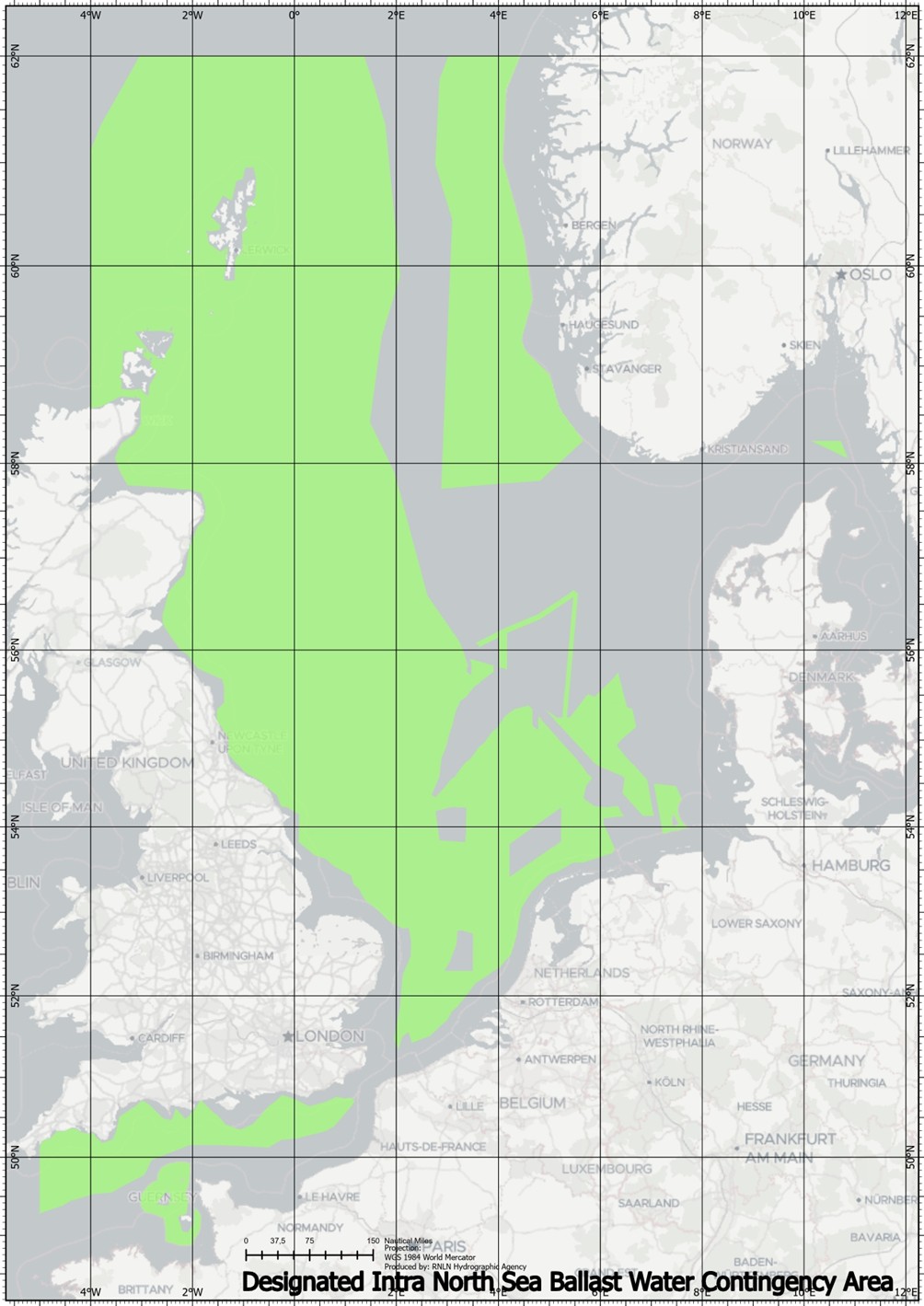
As of 27 June 2025, the North Sea States have formally established the Intra North Sea Ballast Water Contingency Area, allowing eligible vessels to conduct Ballast Water Exchange plus Treatment (BWE+BWT) under defined emergency conditions. This initiative, adopted through the OSPAR framework and aligned with IMO Circular BWM.2/Circ.62 and MEPC.387(81), provides a structured compliance pathway for ships encountering ballast water treatment failures or challenging water quality conditions during intra-North Sea voyages.
To assist shipowners and technical managers in understanding how to operate within this framework, we have prepared a concise step-by-step guide outlining the conditions, actions, and responsibilities required to legally use this designated contingency area.
⚓ Step-by-Step Guide for Using the Intra North Sea BWE+BWT Contingency Area
✅ Step 1: Confirm Eligibility
Only the following ships are allowed to use the area:
- Must comply with BWM Convention Regulation D-2 (i.e. D-2 standard applicable).
- Must be on a voyage between two different ports within the North Sea region.
- Must be facing a valid contingency situation (e.g. BWMS failure or challenging water quality) not caused by:
- Temperature or salinity issues
- Lack of maintenance
- Poor repairs or ignored alarms
- Crew unfamiliarity or error
- Operation outside BWMS design/spec limits (SDL)
Also:
- The ship’s BWMP must incorporate the MEPC.387(81) guidance on challenging water quality.
- The contingency procedures must be already implemented on board.
🛰 Step 2: Notify Port State Authority
Before any bypass or ballast action:
- Inform the receiving port State of the problem.
- Request instructions and notify of any potential non-compliance.
- DO NOT bypass or disable the BWMS before communication.
🛟 Step 3: Consider Reception Facility Alternative
- Discuss with the port State if ballast water can be:
- Discharged to a shore facility
- Treated using a shipboard portable unit
Only proceed to use the contingency area if this is not feasible.
🔧 Step 4: Execute All Onboard Mitigation Actions
Attempt to recover BWMS performance by:
- Waiting for tide/weather improvement
- Backflushing clogged filters manually
- Switching BWMS to high-intensity/alternate mode (e.g., UV boost or USCG mode)
- Reducing ballast rate (down to 50% TRC)
- Using functioning parts (e.g. bypass filter but still treat)
- Ballasting only the minimum safe amount
🗂 Step 5: Ensure Alarm is Not Due to Human or Maintenance Error
The responsible officer must verify:
- Alarms are not caused by crew error, poor operation, or skipped maintenance.
- The system is being operated within limits.
📄 Step 6: Use a Pre-Approved Bypass Agreement (If Available)
If the vessel frequently loads from a port with known poor water quality:
- A pre-arranged agreement may exist with that port State.
- This must be ship-specific, based on previous data.
🚨 Step 7: If Reactive Bypass Occurs
- Immediately inform the next port State.
- Consider returning ballast to same location (Reg. A-3.5).
- Before new uptake, consult the port State again.
⚙ Step 8: Use the Designated Contingency Area for BWE+BWT
- Proceed to the approved coordinates of the contingency area.
- Ensure you:
- Maintain 2 nm distance from offshore structures (wind farms, rigs)
- Avoid Marine Protected Areas (MPAs)
- Respect VTS instructions and restricted zones
🛠 Step 9: If BWMS Requires Repair
- Proceed only if failure was not caused by ship fault.
- Submit a repair plan to both flag State and port State.
📝 Step 10: Record and Document Everything
- Log all actions, alarms, and correspondence in the Ballast Water Record Book (BWRB).
- Retain evidence (emails, logs, manuals followed, etc.).
Need assistance or further clarifications? Contact info@saronmarine.com
 Saron Marine Environmental Services