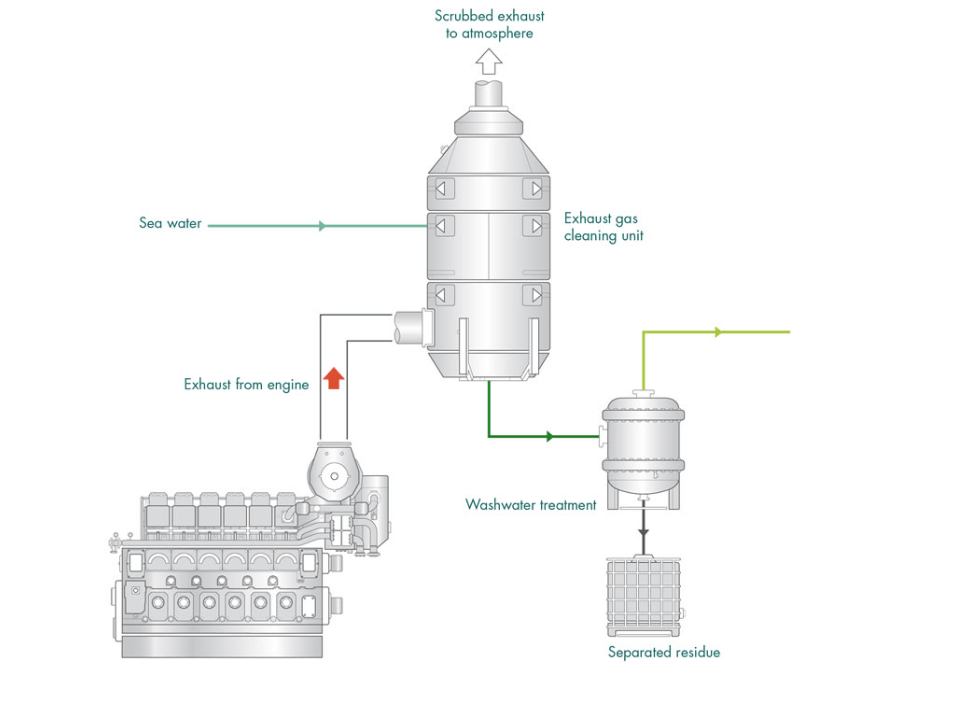
Ships equipped with Exhaust Gas Cleaning Systems (scrubbers) produce washwater as a byproduct of cleaning exhaust gases. This washwater can contain various pollutants (acids, polycyclic aromatic hydrocarbons (PAHs), suspended particles, nitrates, trace heavy metals, etc.) and must meet certain criteria before discharge. International regulations and guidelines define what parameters need to be monitored or tested to ensure the washwater discharge is environmentally acceptable. Below we outline the key requirements for laboratory testing of scrubber washwater samples, distinguishing between mandatory tests and voluntary monitoring under different regimes (IMO guidelines & U.S. VGP,)
At first it would be good to clarify which vessels have a VGP compliant Scrubber (compliance wihtin 3 nm of US shore), as many times, it is confused with ECA Compliant Scrubbers (compliance in the ECA zone)
The basic differentiation those vessels have, are that they produce a discharge that its pH is higher than 6.0 in the point of discharge.
Any ship that her Scrubber does not have the means (i.e. a mode ) that will produce effluent with pH higher than 6.0 at the discharge, cannot use the EGCS into VGP waters, and therefore are not liable to EGCS testign for VGP.
Mandatory Testing Requirement as per IMO Guidelines.
With the exception of the VGP Compliant Scrubbers, that we will discuss later, As of today that this article is written, the only mandatory test, vessels equipped with an EGCS need to perform is the Nitrate test, as stipulated by 2015 EGCS Guidelines (Resolution MEPC.259(68)) and the updated 2021 EGCS Guidelines (Resolution MEPC.340(77)) in the initial and IAPP renewal surveys
Within the first three months of operation after installation/initial survey and three months prior to each renewal survey a sample of the discharge water from each EGCS should be drawn and analysed for nitrate content and results should be made available to the Administration.
As per the latest MEPC, Nitrates discharge data is to be presented as the difference between concentrations in the inlet water and in the discharge water. Therefore 2 samples must be collected in Inlet and Discharge.
Voluntary Testing as per IMO Guidelines.
In addition to the required nitrate testing at renewals, the IMO encourages further sampling on a voluntary basis to gather more data on washwater quality. The latest guidelines (MEPC.340(77) Appendix 3) provide “Guidance for voluntary discharge water data collection.” Ship owners, in cooperation with scrubber manufacturers, are invited (but not required) to periodically sample and analyze scrubber water streams. Specifically, Appendix 3 recommends taking samples of three streams:
- the inlet water (ambient seawater used, for background levels),
- the water after the scrubber (before any treatment or dilution), and
- the final discharge water (after any treatment/dilution).
This voluntary sampling is suggested during the system’s commissioning or shortly thereafter, and then at approximately 12-month intervals for about two years of operation. The purpose is to analyze the washwater in detail for constituents like a range of PAH compounds, potentially heavy metals, nitrate/nitrite, etc., in order to build a broader dataset on scrubber discharges. Appendix 3 is explicitly not mandatory – it is a data-collection initiative to help IMO and scientists assess environmental effects, and its use is voluntary In practice, many ship operators will only do such detailed lab analyses if requested by their administration or if they are participating in research, since the IMO does not enforce it as a requirement.
It is worth noting that no flag state or PSC is currently mandating Periodical Sampling/testing as per MEPC 340.77. Even AMSA, in the latest Notice 12/2022 has dropped the requirement that was intiially established in 2020.
Mandatory Testing Requirements for VGP Permit 2013
As per VGP, Vessel owner/operators must collect and analyze two samples in the first year of permit coverage or system operation, whichever is first, for each of the constituents analyzed in Part 2.2.26.2.3 to demonstrate treatment equipment maintenance, probe accuracy, and compliance with this permit.
Of course this is applicable ONLY to the vessels that have the means to use the EGCS within 3nm US waters, i.e that produce a discharge with pH higher than 6.0
Those Samples must be collected at least 14 days of each other.
Samples must be collected for inlet water (for background), water after the scrubber (but before any treatment system), and discharge water.
If between the Scrubber outlet and Discharge there is no treatment or dilution, (i.e. the washwater is the same in both locations), of course it is not required to collect a 3rd sample and samples only from Inlet and Discharge should be taken
After the first year, samples must be collected at least once per calendar year for inlet water (for background), water after the scrubber (but before any treatment system), and discharge water, and may be collected as part of the vessel’s annual survey as appropriate.
Records of the sampling and testing results must be retained onboard for a period of 3 years in the vessel’s recordkeeping documentation consistent with Part 4.2.
Summarising the requirements
- Mandatory Tests
– Nitrate tests in Surveys Initial/Renewal
– VGP testing for vessels that can use the EGCS within 3 nm of US waters - Voluntary Tests
Annual Test as per MEPC 340.77 requirements
Sources:
1) MEPC 340.77 https://wwwcdn.imo.org/localresources/en/KnowledgeCentre/IndexofIMOResolutions/MEPCDocuments/MEPC.340(77).pdf
2) MEPC 259.68
https://wwwcdn.imo.org/localresources/en/KnowledgeCentre/IndexofIMOResolutions/MEPCDocuments/MEPC.259(68).pdf
3) VGP Permit 2013
https://www.epa.gov/system/files/documents/2025-07/2013-vessel-general-permit.pdf
4.) AMSA Notice 12/2022
 Saron Marine Environmental Services