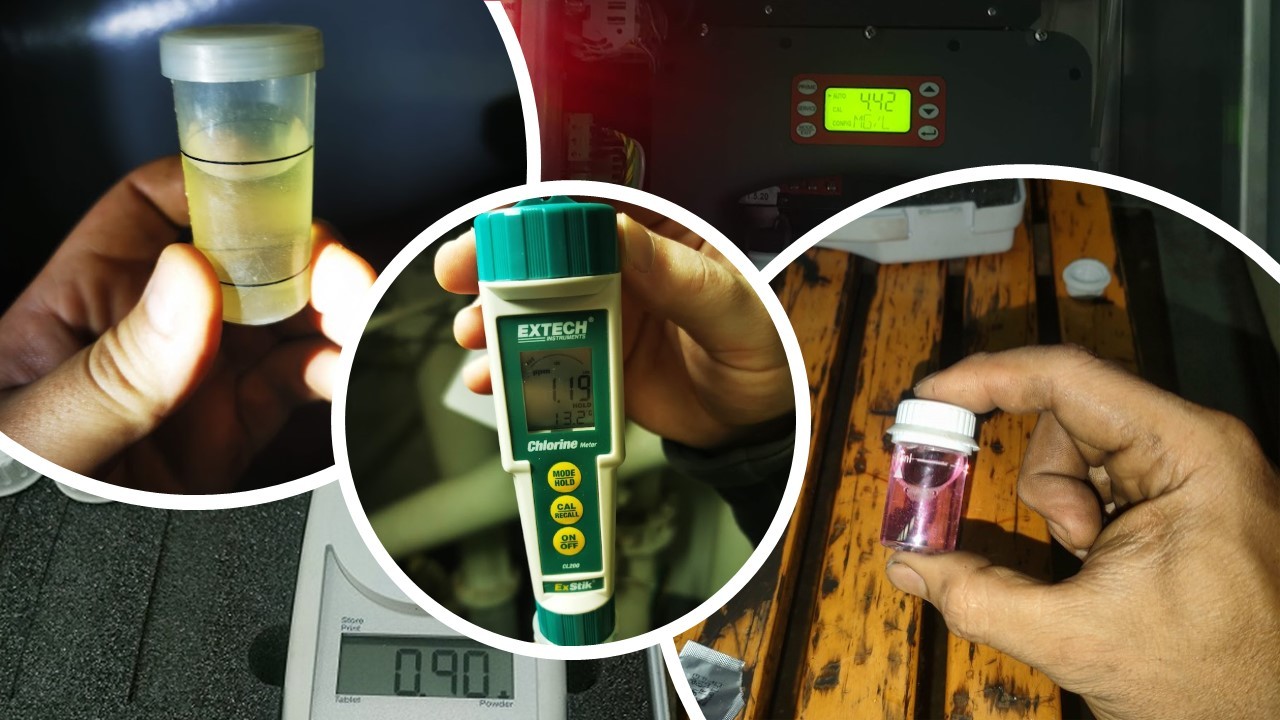
A very common problem faced by operators, is the TRO tests failing the Maximum Allowable Discharge Concentration, while the TRO sensors show correct operation and compliant discharges.
When a TRO test of sample collected from Overboard Discharge Line sampling point is failing the MADC , while the system’s s TRO sensors readings, shows correct operation then the following steps must be followed:
- Take another sample and measurement after 2-3 minutes and verify that this was not a sudden spike to the concentration of TRO.
- Stop the deballasting, shut down the BWM system, restart it and after 10 minutes that it has normalized its operation, collect sample from G-2 Sampling point and do one more TRO test.
- If is verified again is off-limits, ship must STOP deballasting and the relevant BWMS units to be checked, namely the TRO sensors (reagents, tubes, pumps, valves, cuvette), the ANU and the ANU tank, the TRO lines/pumps and ANU lines/pumps as well as the relevant valves in those lines, especially the non-return for clogging. Consult BWMS Manual.
- Once corrective actions take place, restart the system, take samples after 10 minutes and confirm all in order by taking one more sample.
- If the TRO is still above MADC, then the ship MUST stop deballasting, the crew must follow the contingency measures described in Class approved BWMP !here we all laugh, but I had to write it! and inform the Port Captain, their technical and operations management teams of the situation and seek immediate guidance/assistance from the BWMS Maker.
- If everything is in order and TRO is below MADC after corrective actions, then you can continue deballasting.
If this failure, took place, within US waters, make sure that you make a Corrective Assessment/Actions report as per Chapter 3 of Final 2013 VGP and same must be reported in the Annual Report as non-compliance. You must retain the findings of your corrective action assessment in your recordkeeping documentation or in your ship’s log (pursuant to Part 4.2), signed and certified in accordance with Part 1.7 of VGP permit.
If you do face such issues, do not hesitate to contact Saron Marine Environmental Services @ info@saronmarine.com or +30 210 80 80 835
 Saron Marine Environmental Services